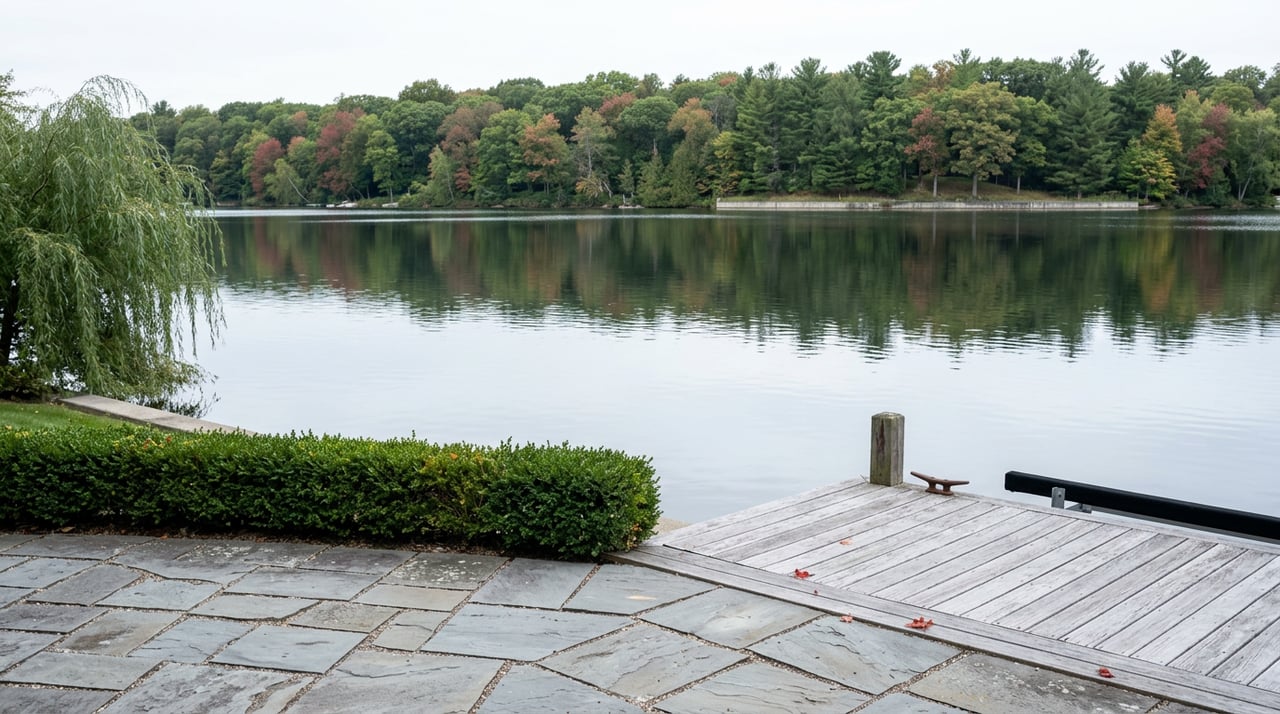
What "Lake Access" Actually Promises on Wayzata Bay
A buyer touring a cottage inside the Groveland Homeowners Association on Wayzata Bay sees the same three words on every listing that catches their eye: deeded lake access. It sounds settled. It sounds like the boat problem is solved before the offer is even written. Then, somewhere in the disclosure packet or a phone call to the association, a different sentence shows up: a dock is available through a waitlist, assigned by application date and homeowner seniority.
That single clause is close to the whole story of buying or selling near Lake Minnetonka in Wayzata right now. The word "access" tells you almost nothing about whether you'll have a boat in the water next summer. What tells you is a set of bylaws most buyers never read until they're deep into a purchase agreement, and a regulatory body, the Lake Minnetonka Conservation District, that decides whether a property can legally hold a dock at all. Getting this wrong doesn't just cost a summer. It can sit quietly in a file until a buyer's attorney or a seller's disclosure catches up to it.
Lake Minnetonka properties sort into three access categories, and each one handles dock rights differently at closing.
True riparian frontage means the lot line meets the water. The owner holds shoreline directly and can apply for a dock under LMCD rules. This is the only category where the dock right lives in the deed itself rather than in a separate agreement.
Association-administered access, like Groveland's, is different. The HOA owns or controls the shoreline, and members share a fixed number of docks through a waiting list. Groveland began in 1902 as a twelve-acre parcel leased to summer cottagers, later reorganized into a homeowners association governed by an elected board. Today the community shares a limited set of docks among its member residences, with slot assignment running on application timing and how long a household has owned in the community. That's a queue, not a benefit bundled with the deed. A nearby community, the Herzog Association, runs a similar structure on Wayzata Bay: a beach, picnic grounds, and boat docks available to eligible owners through its own waiting list.
Municipal license programs are the third category, and they work more like a rental than a right. Minnetonka Beach, a small lake city distinct from the larger city of Minnetonka, holds a multiple dock license through the LMCD covering roughly 80 slips scattered across town. The program was built to give non-riparian homeowners lake access, and it runs on six priority levels with a separate waiting list for each specific dock location. Slip renters get first option to renew each year, but the license itself belongs to the city, not to any single house. A buyer who assumes a home comes with a boat slip because a past owner had one may be starting at the back of that list the day the sale closes.
| Access type | Who controls the dock | Transfers at closing? |
|---|---|---|
| True riparian frontage | Owner applies directly to LMCD | Right to apply transfers with the deed |
| HOA-administered (Groveland, Herzog) | Association board and bylaws | No automatic slot; buyer joins the waitlist |
| Municipal license (Minnetonka Beach model) | City-held license, LMCD-issued | No; slip is city-administered and reassigned |
Even true frontage doesn't guarantee a legal place to put a dock. The LMCD's Dock Use Area rules set back distances from property lines and cap how far a structure can extend into the water, and approval depends heavily on lot width. A narrow parcel on a popular bay can leave an owner holding full riparian rights with no conforming spot to install one. For single-family homeowners, the LMCD generally doesn't require an annual permit or license unless the property stores five or more watercraft or shares at least 226 feet of shoreline, but that's a different question from whether a dock can be built there in the first place. A buyer comparing frontage against association access should ask the same question either way: has anyone actually confirmed the dock is legally conforming, or is that just an assumption built into the asking price?
Buyers and sellers also need to know that the operating environment for docks and boats on Lake Minnetonka has been shifting, and 2026 brought two developments worth understanding before a showing turns into a purchase agreement.
The LMCD's 2023 ordinance set a 300-foot buffer from shoreline and a 150-foot buffer from docks, anchored boats, and swimmers for wake-producing boats. This year the district went further. At a May 2026 update to the Shorewood City Council, the LMCD confirmed a new 5 mph speed limit for all watercraft within that same 300-foot band, tightening how close boats can move at speed near private shoreline and docks.
At the same time, the district chose not to go further than that. Following an April 22, 2026 decision, the LMCD declined to adopt a stricter 600-foot buffer for wake boats that had been recommended in University of Minnesota St. Anthony Falls research and pushed by the advocacy group Citizens for Sharing Lake Minnetonka. The board kept the existing 300-foot line in place heading into this boating season. For a shoreline property, that means the practical experience of owning a dock, how close wake boats legally come, how fast traffic moves near the beach, is not fixed. It's an active regulatory conversation, and it's worth understanding where a specific bay or association stands in that conversation before assuming today's rules will look the same in a few years.
A short list settles most of the ambiguity that otherwise surfaces mid-transaction:
None of these require an attorney to check on day one, but several of them benefit from one before contingencies come off.
Across Lake Minnetonka, true lakefront tends to start near a million dollars on the more modest west-end bays and regularly clears ten million dollars on premier stretches like Smithtown Bay, Browns Bay, and Big Island. Deeded-access and association properties, the Grovelands and Herzogs of the lake, generally land well under that lakefront floor. That gap isn't random. It's the market pricing in exactly the uncertainty this piece has walked through: you're not paying lakefront prices, but you're also not guaranteed lakefront use on your own timeline. Wayzata's broader home value index sat at $940,771 as of July 31, 2026, up 5.5 percent over the prior year, a number that blends everything from inland homes to true frontage and undersells how much of that spread is explained by which access tier a property actually sits in.
Does a dock license automatically transfer when a home sells? It depends entirely on the category. True riparian frontage transfers the right to apply. HOA-administered docks and municipal licenses generally do not transfer automatically and require the new owner to apply and often wait.
Does the LMCD have to approve a dock for every waterfront property? No. Frontage grants the right to apply, not automatic approval. Lot width and Dock Use Area setback rules determine whether an application succeeds.
If an association's waitlist is years long, is there anything a buyer can do? Reviewing the association's current bylaws and asking for a specific waitlist position before writing an offer is the only way to know what you're actually buying into, rather than what the listing implies.
Dock rights on Lake Minnetonka reward the buyers and sellers who ask specific questions early and protect the ones who assume a word on a listing sheet means what it sounds like. If you're weighing a lakefront purchase, an association property, or you're preparing to sell a home with any of these access arrangements, Nicole Stone can walk through the actual documentation, bylaws, and LMCD history behind a specific address before you're committed to anything. Schedule a free consultation to get the paperwork sorted before the paperwork sorts you.



We pride ourselves in providing personalized solutions that bring our clients closer to their dream properties and enhance their long-term wealth. Contact us today to find out how we can be of assistance to you!